Strategy guide
Meowdoku Tips & Strategy
Every Meowdoku board has one logical solution, so the goal isn’t speed or luck — it’s never guessing. These habits turn a board that looks stuck into a chain of forced moves.
New to the puzzle? Start with the How to Play guide for the rules and controls, then come back here to sharpen your solving.

Try these Meowdoku tips on a live board
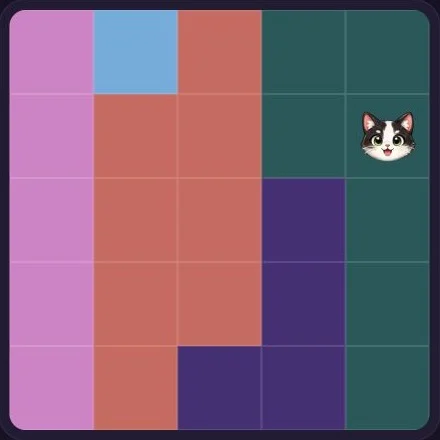
The board below is a real Meowdoku, dealt fresh and playable right here on the page — not a picture of one. Solve it and you already know the game: the campaign levels on this site follow these exact rules, just on larger grids with more colored regions.
Same rules as every Meowdoku board: one cat per color, row, and column — and no two cats touching.
Stuck? Peek at the solved board
The cats go in row 1 column 1, row 2 column 3, row 3 column 5, row 4 column 2, and row 5 column 4. Notice how each one sits alone in its color, its row, and its column, with no two cats touching.
Six habits that clear any board
- Tip 1Mark ✕ before you place anything.The ✕ marks are your working memory — the more squares you rule out, the fewer places remain for each cat. On a 5×5 board, marking row, column, and neighbor exclusions for one cat often reveals the next forced cat instantly.
- Tip 2Treat every cat as a fence.The moment you place a cat, cross out all eight squares around it plus its entire row and column. That fencing cascades: once a region has only one square left, you know where its cat goes.
- Tip 3Solve the tightest regions first.Small corner and edge regions have the fewest legal squares, so their cat is forced earlier. Large central regions can wait — by the time you get to them, the board will have narrowed them down.
- Tip 4Squeeze single-line regions.When a colored region can only fit its cat inside one row or column, cross out the rest of that row/column for other regions — that one cat claims the entire line.
- Tip 5Re-scan after every placement.Good Meowdoku solving is a chain reaction. Every cat you place eliminates up to 16 squares (row + column + 8 neighbors), which often forces another region’s cat on the first scan. Don’t skip the re-scan.
- Tip 6Never guess — back out contradictions.If a move forces two cats to touch or leaves a region with nowhere to go, undo it immediately. That “wrong” move is actually a deduction: you proved the square must be an ✕, so mark it and move on.
When a board feels stuck
Being stuck almost always means there’s a nearly-full line or region you haven’t scanned in a while. Pick a row or column that already has several ✕ marks and ask: "Which cell here could legally hold a cat?" Narrow it down to two or three candidates, then check each against the rest of the board. One of them will create a contradiction almost immediately — eliminate it, and the board unlocks.
A practice path
Build the two core habits — ✕-first and the cat-as-fence rule — on a 5×5 Easy board. When you can solve one in under a minute without hints, move to 7×7 Normal. The campaign levels are designed to teach you the patterns in order: early levels give you single-square freebies, while later ones force you to chain four or five deductions before the next cat appears.
 ▶ Play a board now
A worked example: turning one ✕ into a solved line
Most Meowdoku breakthroughs come from a single well-placed ✕. Here is the exact chain of reasoning a strong solver runs on a fresh board:
- Scan for the smallest region. On a 5×5 board it is usually a two- or three-cell shape tucked in a corner — its cat has the fewest legal homes, so it resolves first.
- Mark every square that shares a row or column with a cat you have already placed. These ✕ marks are free deductions: they cost nothing and shrink every other region.
- Look for a row or column that now has only one blank square left. That square is forced — place its cat, then immediately fence off its eight neighbours.
- Re-scan the regions touching the cat you just placed. One placement removes up to sixteen squares, which usually forces the next cat with no guessing.
- Repeat until every region, row, and column holds exactly one cat. If two squares ever look equally legal, you missed an ✕ earlier — back up and find it instead of guessing.
Advanced Meowdoku tips for 7×7 and 9×9 boards
Bigger boards never change the three rules, but they reward a few extra habits. These advanced Meowdoku tips keep large grids from feeling overwhelming:
- Partition the board into bands.On a 9×9 grid, solve the top rows almost as their own puzzle before touching the bottom. Cats placed high create ✕ chains that cascade downward, so a clean top half makes the rest far easier.
- Count a region’s legal squares.If a colored region has exactly as many blank squares left as cats it needs, every one of those squares is forced. Larger boards hide these one-answer regions — hunt for them on purpose.
- Play two touching regions as a pair.When regions share an edge, a cat in one fences squares in the other. Solving them together often forces both cats at once and saves several scans.
- Track the fish crackers, not the clock.On Hard boards the temptation is to rush. Resist it: one wrong cat costs a life and three end the board, so a slow, fully-justified solve beats a fast guess every time.
Further reading
Meowdoku tips: quick answers
What is the single most useful Meowdoku tip?
Mark ✕ before you place any cat. The ✕ marks record every square a cat cannot occupy, and once a row, column, or region has only one blank left, that cat is forced. Solving flows from elimination, not from placing cats and hoping.
How do I get faster at Meowdoku?
Speed comes from re-scanning, not rushing. Every cat you place removes up to sixteen squares, so a quick scan after each placement usually reveals the next forced move. Chain those deductions and a 5×5 board falls in under a minute with no guessing.
What should I do when I get stuck?
Find a line or region that is almost full and already carries several ✕ marks, then ask which single cell could still legally hold a cat. Narrowing one crowded line to its only legal square almost always restarts the chain.
Do these Meowdoku tips work on every board size?
Yes. The ✕-first habit, the cat-as-fence rule, and solving the tightest region first apply equally to Easy 5×5, Normal 7×7, Hard 9×9, and Extreme 10×10 boards. Larger grids just add more regions and longer deduction chains.
Is it ever okay to guess in Meowdoku?
No board requires it. Every Meowdoku puzzle has exactly one solution reachable by logic alone, so a guess only risks a fish cracker. If two squares look equally valid, a missed ✕ is hiding elsewhere — find it instead.
Where can I practise these tips?
Use the live board above, or open a fresh puzzle, the daily challenge, or the 150-level campaign on the home page. The campaign introduces patterns in order, so each level rehearses one more of these tips.