
Meowdoku vs Queens: Rules, Differences, and Which to Play
Meowdoku and Queens belong to the same family of colored-region placement puzzles. Their core rules are almost identical; the biggest differences are the theme, the available board sizes, and what you can play after today’s puzzle is finished.
Same logic. More ways to play.
Queens rules.
Cat energy.
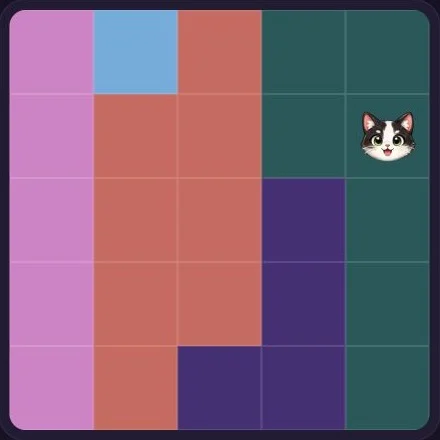
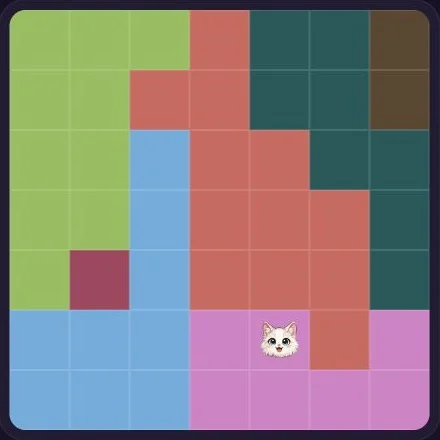
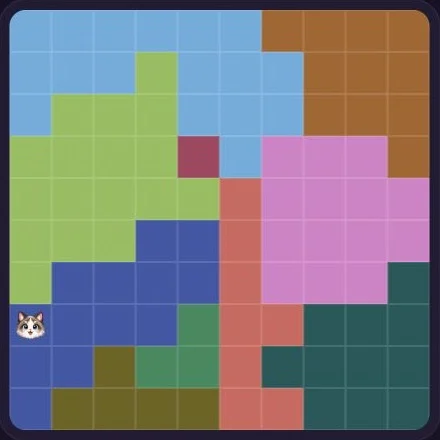
Start with a quick 5×5, climb to a 10×10 challenge, or keep going through Daily and Campaign boards.
Are Meowdoku and Queens the same game?
Meowdoku and Queens use the same four-part logic system: one piece per row, one per column, one per colored region, and no touching pieces. A legal finished board in one game could therefore be checked with the rules of the other after you swap the cat and crown symbols.
They are not the same product. LinkedIn’s Queens presents the puzzle as part of its daily games collection. Meowdoku is a separate cat-themed game with its own boards, progression, controls, hints, and play modes. Neither game’s level numbers or solutions transfer to the other.
Meowdoku vs Queens rules
Every move has to satisfy all four rules at once. The colored regions can bend around the grid, so “one per region” is not just a second version of the row rule.
- Exactly one symbol in every row. A row with a cat or queen cannot contain another.
- Exactly one symbol in every column. Each column must also finish with one.
- Exactly one symbol in every colored region. Region shape does not matter; each color gets one symbol.
- No two symbols may touch. Side-by-side, above and below, and diagonal contact are all forbidden.
The diagonal part is the rule new players miss most often. Two pieces in neighboring rows and neighboring columns touch at a corner even though they do not share a row or column.
Meowdoku vs Queens: side-by-side comparison
| Feature | Meowdoku | Queens |
|---|---|---|
| Piece | Cat | Queen or crown |
| Rows, columns, regions | Exactly one cat in each | Exactly one queen in each |
| Touching rule | No touching, including diagonals | No touching, including diagonals |
| Board look | Warm colored regions and cat art | Colored regions with a crown theme |
| Ways to play | Free play, daily challenge, and 150 campaign levels | A daily puzzle in LinkedIn Games |
| Board sizes | 5×5, 7×7, 9×9, and 10×10 in free play | The daily board chooses the grid for you |
| Help in Meowdoku | ✕ marks, undo, optional auto-cross, and hints outside the Daily | Uses the Queens interface and daily result flow |
| Best fit | Players who want more boards and a difficulty ladder | Players who want one shared daily challenge |
The biggest difference is what happens after one puzzle
The core deduction feels remarkably similar. Place one cat in Meowdoku and you can eliminate its row, column, colored region, and eight neighboring cells — exactly the same information cascade a Queens placement creates.
The surrounding experience is where the games separate. Queens is easy to fold into a daily routine because everyone receives that day’s puzzle. Meowdoku also has a shared daily challenge, but it does not stop there: free play lets you choose Easy 5×5, Normal 7×7, Hard 9×9, or Extreme 10×10, while the campaign arranges 150 boards into a progression.
That makes Meowdoku useful as a Queens alternative when one daily board is not enough. You can learn the rules on a compact grid, repeat a size until the patterns become automatic, and then move upward without changing the rules.
Which puzzle should you play?
Choose Meowdoku if…
- you want to play more than one puzzle today;
- you want selectable 5×5, 7×7, 9×9, and 10×10 boards;
- you like campaign progression and numbered levels;
- you want hints, undo, and optional automatic ✕ marks;
- cats make a logic grid more inviting to you.
Choose Queens if…
- you want one official LinkedIn puzzle each day;
- you like comparing a daily result with friends or colleagues;
- you prefer the queen or crown theme;
- one carefully chosen board is enough for your routine;
- you already use the other LinkedIn Games.
You do not have to choose permanently. The skills transfer almost perfectly. Queens can be the daily event; Meowdoku can be the place you practice the same style of deduction whenever you want another board.
Five solving strategies that transfer between both games
1. Mark exclusions before placing a piece
Do not ask only where a cat or queen could go. First record where it cannot go. Once a row, column, or region is reduced to one legal cell, the placement is forced rather than guessed.
2. Start with the smallest colored region
A region with two or three available cells carries more information than a sprawling region with eight. Tight regions often produce the first useful eliminations.
3. Use a region trapped in one line
If every remaining cell of a region lies in the same row, that region’s piece must occupy that row. All cells in the same row but outside the region can be crossed out. The same logic works with columns.
4. Clear all eight neighbors
After every placement, eliminate the horizontal, vertical, and diagonal neighbors immediately. Missing one corner cell can leave the board looking ambiguous several moves later.
5. Rescan rows, columns, and regions equally
All three containers need exactly one piece. A forced move can appear in any of them after a single new ✕, so rotate your scan instead of staring at colored regions alone.
How difficulty changes in Meowdoku
Meowdoku difficulty grows by increasing both grid size and the length of the deduction chain. Easy uses a 5×5 grid with five cats. Normal moves to 7×7, Hard to 9×9, and Extreme to 10×10. The rules never change, but a larger board asks you to track more rows, columns, regions, and blocked neighbors at once.
The browser campaign starts with smaller, more readable boards and grows to 150 levels. If you arrived after enjoying Queens, an Easy or Normal Meowdoku is the cleanest bridge; move up when you can finish without guessing or spending a hint.
Frequently asked questions
Is Meowdoku a Queens clone?
No. Meowdoku and Queens are separate games in the same placement-puzzle family. They share rules, just as many sudoku apps share sudoku rules, but their boards, visual themes, play modes, progression, and interfaces are different.
Can I use Queens strategies in Meowdoku?
Yes. Row and column elimination, region lockouts, no-touching deductions, and forced-cell scans work in both. You only need to read cats as queens and keep the same constraints in mind.
Does Meowdoku have a daily puzzle?
Yes. Meowdoku has one shared 10×10 Daily Challenge for each date, plus free-play boards and a 150-level campaign when you want more.
Can I play Meowdoku without downloading an app?
Yes. The browser version runs without an account or download. Progress, best times, and campaign completion are stored locally on the same device.
What should a Queens player try first?
Start with a 5×5 Easy board to learn the cat controls, then try 7×7 Normal. The logic will already feel familiar; the main adjustment is using Meowdoku’s ✕, hint, and auto-cross tools.
Try a Queens-style cat logic puzzle
If the daily Queens grid leaves you wanting one more puzzle, Meowdoku gives the same one-per-row, one-per-column, one-per-region challenge with cats and a full difficulty ladder. No account or download is required.
Queens is a LinkedIn game. Meowdoku Playbook is not affiliated with LinkedIn or the Queens game.