Beginner guide
How to Play Meowdoku
Meowdoku is a cat logic puzzle you solve by pure deduction — no math, no guessing. This guide walks you through the goal, the three rules, the controls, and your very first move.
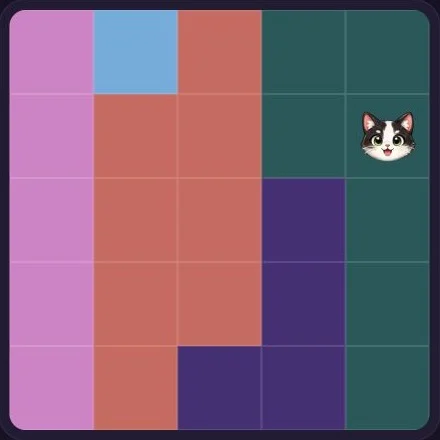

How to play Meowdoku in under a minute
- Pick a board size — start with Easy (5×5) while you learn the rules.
- Find the smallest colored region and rule out impossible squares with an ✕.
- Place one cat in every region so each row and column ends up with exactly one too.
- Never let two cats touch — not even diagonally.
- Clear the whole board before you spend all three fish crackers.
Try it: a live practice board
This is a real 5×5 Meowdoku you can solve right here. Click a cell once to mark it with an ✕, twice to place a cat, and a third time to clear it. Give every color, row, and column exactly one cat, and keep the cats from touching.
Same rules as every Meowdoku board: one cat per color, row, and column — and no two cats touching.
Stuck? Peek at the solved board
The cats go in row 1 column 1, row 2 column 3, row 3 column 5, row 4 column 2, and row 5 column 4. Notice how each one sits alone in its color, its row, and its column, with no two cats touching.

The goal
Every Meowdoku board is a grid split into colored regions. Your job is to place cats on the board so that the whole grid obeys three rules at once. When every region, row, and column has exactly one cat and no two cats touch, the puzzle is solved. Each board has a single correct answer you can always reach by logic alone.
The three rules
- 1One cat per region. Each colored region holds exactly one cat — no more, no fewer.
- 2One cat per row and column. Every row and every column holds exactly one cat, just like Sudoku.
- 3Cats can’t touch. No two cats may sit in neighboring squares — horizontally, vertically, or diagonally.
That third rule is what makes Meowdoku special. Every cat you place fences off all eight squares around it, so one good placement often forces several more.
The controls
You play a whole board with two simple taps:
- Tap a cell mark it with an ✕
- Double-tap a cell place a cat there
- Tap a cat again to remove it
You start each board with three fish crackers — your lives. Placing a cat that breaks a rule costs one fish cracker, so the ✕ marks are your safety net: the more carefully you rule out impossible squares first, the fewer mistakes you make.
Why you lost a fish cracker
Every rule-breaking placement costs one of your three fish crackers. These four slips catch most new players — avoid them and you’ll rarely lose a life.
- Placing a cat before marking ✕.The ✕ marks are how you prove a square is impossible. Rule squares out first, then place the cat that has nowhere else to go.
- Forgetting the diagonal.The no-touching rule includes the four diagonal neighbors, not just up, down, left, and right. Each cat fences off all eight squares around it.
- Guessing inside a tight region.If two squares in a region both still look legal, you’ve missed an ✕ somewhere else. There is always a forced move — find it instead of guessing.
- Ignoring the fish-cracker count.Three mistakes end the board. When you’re down to your last cracker, slow down and place only cats you can fully justify.
Your first move
Open a fresh board and look for a colored region that has only one or two squares left. In a 5×5 board, the corner regions are often the easiest because they wrap around fewer neighboring cells. Place an ✕ on any square that violates a rule, then scan again — a region that looked open may now have only one legal cell left.
After placing your first cat, cross out every square around it — rows, columns, and all eight neighbors. The board shrinks quickly, and you’ll spot the next forced cat within a few seconds. If you get stuck, use a hint. Hints never reveal the answer — they point to a cell that is forced by the rules you already placed.
Boards and modes
Meowdoku boards come in four sizes: Easy (5×5), Normal (7×7), Hard (9×9), and Extreme (10×10). Larger boards have more regions, more cats, and longer deduction chains, but the three rules never change. You can play a single free puzzle, tackle the daily challenge (the same board for everyone each day), or work through the campaign of 150 hand-crafted levels that grow from 5×5 up to 10×10.
▶ Play Meowdoku free
How Meowdoku differs from Sudoku
If you know Sudoku, you already understand two of Meowdoku’s three rules: one symbol per row and one per column. Meowdoku swaps Sudoku’s 3×3 boxes for irregular colored regions, drops numbers entirely, and adds the rule that no two cats may touch. That last rule does most of the work — place a single cat and you instantly eliminate every neighboring square. It’s the same deductive payoff as Sudoku with far less bookkeeping, which is why players who want a lighter, cat-themed logic puzzle end up here.
How to play Meowdoku: quick answers
How do you play Meowdoku?
Place one cat in every colored region so that each row and each column also holds exactly one cat, and no two cats sit in touching squares — including diagonals. Solve it by deduction: mark impossible squares with an ✕, then place the cat that has only one legal home left.
Do you need to be good at math to play Meowdoku?
No. Meowdoku has no arithmetic at all. Every board is solved by pure logic — if a square would break one of the three rules it’s out, and whatever square is left must hold a cat.
What are the fish crackers for?
Fish crackers are your lives. You start each board with three, and placing a cat that breaks a rule costs one. Run out and the board ends, so the ✕ marks are your safety net against mistakes.
How big are Meowdoku boards?
Boards come in four sizes: Easy 5×5, Normal 7×7, Hard 9×9, and Extreme 10×10. Larger boards add more regions and longer chains of deduction, but the three rules never change.
Can every Meowdoku puzzle be solved without guessing?
Yes. Each board has exactly one solution that logic alone can reach. If you feel stuck there is always a forced move you haven’t spotted — or you can use a hint, which points to a forced cell without revealing the whole answer.
Is Meowdoku free to play?
Yes. You can play a free puzzle, the shared daily challenge, or the 150-level campaign right in your browser — no download and no account required.